
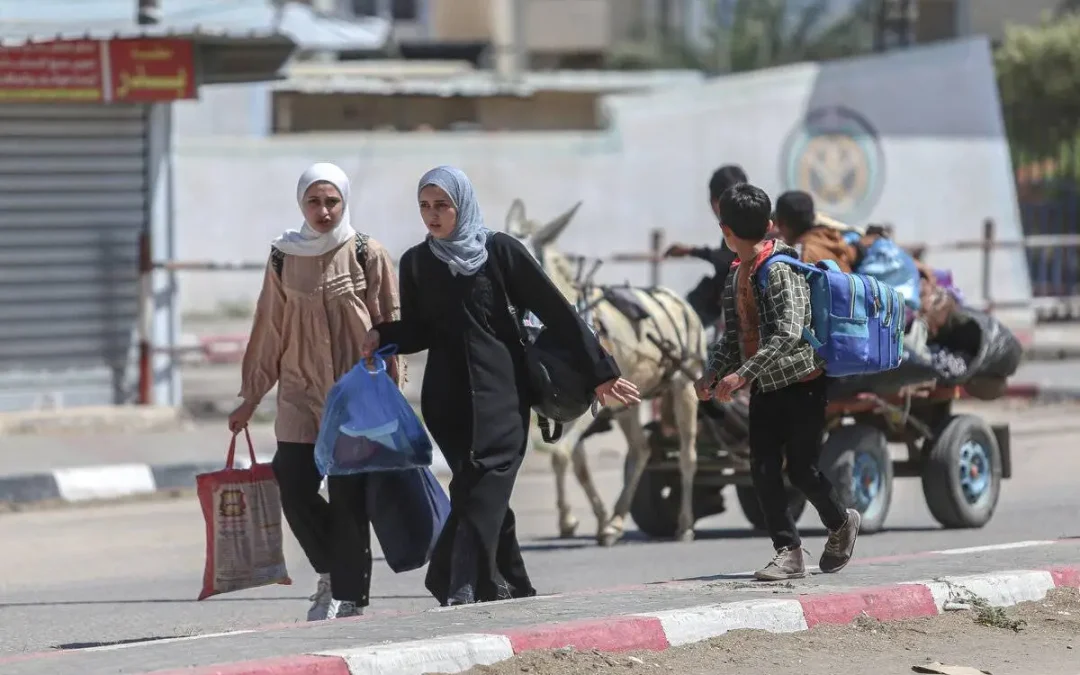
The report of Palestinians scrambling for safety ahead of an expected operation in Rafah underscores the heightened tensions and fear gripping the region amidst the ongoing conflict.
Facing the prospect of military action, civilians in Rafah are forced to make desperate attempts to seek safety for themselves and their families. The anticipation of an operation exacerbates an already precarious situation, with residents grappling with the constant threat of violence and displacement.
The situation highlights the urgent need for measures to protect civilian populations and uphold their rights to safety and security. It also underscores the imperative for all parties involved to exercise restraint and prioritize the protection of civilian lives, in accordance with international humanitarian law.
Efforts must be made to de-escalate tensions, facilitate humanitarian access, and ensure the safety and well-being of all civilians affected by the conflict. Additionally, diplomatic efforts should be intensified to seek a peaceful resolution to the underlying issues fueling the conflict and to address the legitimate grievances of all parties involved.
In the meantime, the international community must stand in solidarity with the people of Rafah and provide the necessary support and assistance to alleviate their suffering and help them rebuild their lives in safety and dignity.
As battles raged on the outskirts of Rafah on Wednesday with Israeli forces closing in, Palestinians were on the move again, abandoning neighbourhoods of the southern Gaza city and leaving them as ghost towns, Reuters reports.
Israel has threatened a major assault on Rafah to defeat thousands of Hamas fighters it says are holed up there, but more than a million people are sheltering in the city, prompting warnings from the United Nations of a humanitarian catastrophe.
Israeli forces tasked with destroying the Palestinian group, Hamas, on Tuesday seized the main border crossing between Gaza and Egypt in Rafah, cutting off a vital route for aid into the enclave, where malnutrition is widespread.
Israel’s military said it was conducting a limited operation in Rafah to kill fighters and dismantle infrastructure used by Hamas, which runs Gaza. It told civilians to go to an “expanded humanitarian zone” some 20 km (12 miles) away.
Three residents of Rafah told Reuters by telephone that tens of thousands of people have fled the city, which was seen as the last refuge for Palestinians who have been displaced many times over as Israeli air strikes pulverised Gaza.
People in the Jneina, Al-Shawka, Al-Salam and other neighbourhoods were ordered by the Israeli army to leave in anticipation of an assault. Some 1.4 million people have been sheltering in Rafah, raising the prospect of major casualties.
“Some streets look like a ghost town now,” said Aref, 35, who asked not to be named, fearing Israeli reprisals.
“We don’t fear death and martyrdom, but we have kids to care for and live for another day when this war ends and we rebuild the city,” he told Reuters via a chat app.
The war erupted on 7 October when Hamas fighters crossed into Israel from Gaza and killed 1,200 people and took more than 200 hostages back to the enclave, according to Israeli tallies.
However, since then, it has been revealed by Haaretz that helicopters and tanks of the Israeli army had, in fact, killed many of the 1,139 soldiers and civilians claimed by Israel to have been killed by the Palestinian Resistance.
Warnings
Israel responded with air and artillery strikes which have killed nearly 35,000 people, Gaza health authorities say, and turned much of one of the most densely populated areas in the world into a wasteland of rubble.
Many Rafah residents said they received warnings over their phones, and planes dropped leaflets.
Juliette Touma, Director of Communications of the UN Palestinian refugee agency, UNRWA, estimated that around 10,000 Palestinians have left Rafah since Monday.
The Gaza government media office put the number of people fleeing at tens of thousands and warned against a “massacre”.
Residents said tanks, which had moved in to take control of the Crossing, had not entered built-up areas of the city and gun battles were still outside the city limits.
Suleiman Abu Kweik and his family are being displaced for the fourth time.
“Our homes have been destroyed. In Gaza (City) our house … they destroyed it. It was shelled. We went to Khan Yunis. When they threatened Khan Yunis, we went to Rafah,” he said.
Hamas said its fighters were battling Israeli forces in the east of Rafah. Lines of smoke from air strikes and tank shelling rose from places east of the city, residents said.
“Some people are still staying in their homes, even in the red zone areas, but I daresay that tens of thousands have already left Rafah, including from areas west of the city, that are not included in the Occupation army warning,” said Mohammed Emad, 34, a father of three.
Abu Ahmed Al-Najar said more than 60 families who lived in tent camps in Al-Jneina neighbourhood in Rafah had all left the area late on Tuesday.
“Sixty-five families or 400 people are now homeless. People have no money, no tents, no one to support them,” he said.
Some people, like Mazen Ghadour, loaded their meagre belongings onto old trucks.
“This is the third or fourth time we have had to move. We are eight families. We live in fear. There is no safe place in the entire Strip,” he said.
“God knows where we will go. We are going to the unknown. We are going to the unknown.”
To read more detailed coverage check out the source of this news: