
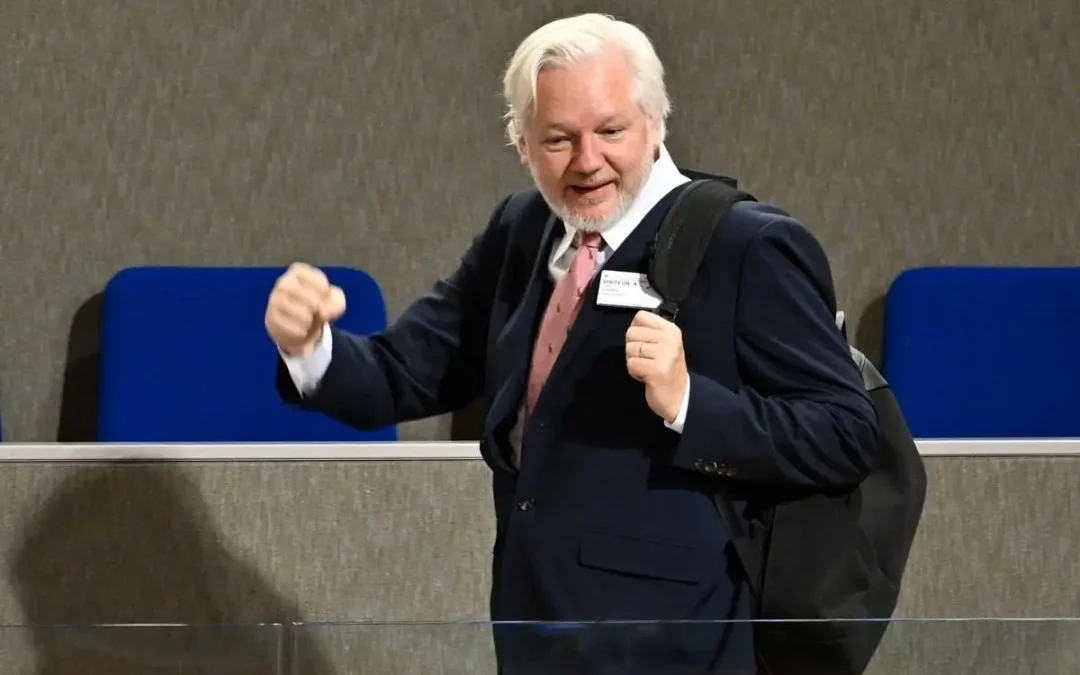
The Parliamentary Assembly of the Council of Europe (PACE), on Wednesday, officially designated WikiLeaks founder, Julian Assange, as a “political prisoner”, Anadolu Agency reports.
A motion, which called attention to Assange’s ongoing detention and the punitive actions he has faced, was passed with 88 votes in favour, 13 votes against, and 20 abstentions.
It emphasized that a free press is crucial to the functioning of democratic states, and welcomed the release of Assange, recognising his role in exposing information that highlighted potential human rights violations and war crimes.
The motion criticised UK authorities for their failure to protect Assange’s freedom of expression, and urged the US to reform its espionage laws, which have led to severe charges against the journalist and publisher.
PACE called on the US to carry out an impartial investigation into the allegations WikiLeaks revealed, including those related to human rights abuses.
Under the charges brought against Assange under US espionage law, he faces the prospect of life imprisonment—an outcome the assembly labelled as “disproportionate” given that his actions are centred on gathering and publishing information.
PACE affirmed that the charges fit the criteria outlined in its Resolution 1900, which defines the conditions of a “political prisoner”, justifying Assange’s classification under this label.
During the session, Irish parliamentarian, Paul Gavan, delivered a pointed speech, calling the decision one of PACE’s “best moments”, contrasting it with what he described as the body’s failure to take a stronger stand on other global human rights crises.
Gavan also praised Assange’s address to PACE’s Committee on Legal Affairs and Human Rights, voicing strong support for the efforts toward securing his freedom.
Austrian parliamentarian, Petra Bayr, commended Assange for his enduring courage over the years, noting the significance of his presence at PACE just three months after his release.
Her sentiments were echoed by Christophe Brico from Monaco, who underscored the critical role of free journalism in safeguarding democracy and protecting the integrity of information sources.
Assange rose to fame in the 2010s for leaking classified US documents on the internet, gaining him international accolades and detractors when he exposed sensitive American diplomatic correspondence and military records, including a video of a 2007 US air strike in Baghdad that killed several people, including two Reuters journalists.
Assange has doggedly opposed extradition to the US and spent seven years in the Ecuadorian Embassy in London in a bid to prevent the handover.
He was ejected from the diplomatic compound in 2019 and has spent the last five years in a British prison as he fought an extradition order to the US.
He was freed after formally accepting a plea deal in a federal court on the Northern Mariana Islands, a remote US territory in the western Pacific that saw him plead guilty to a felony charge of violating the Espionage Act related to his publication of military and diplomatic documents.
He then flew on to his native Australia where he was greeted by his wife, Stella.
To read more detailed coverage check out the source of this news