
In 2013, Elias Khoury, the renowned Lebanese novelist and public intellectual, delivered a speech from Beirut via Skype to a group of 250 Palestinian activists. The activists had just established an encampment in the E1 area of the occupied West Bank, located between Jerusalem and Jericho, as an act of resistance. They called their encampment “Bab Al-Shams,” after Khoury’s novel of the same name.
In contrast to the activists, Khoury has never lived in Palestine, nor has he ever even been granted the opportunity to visit. Nevertheless, he told the activists: “I will not say, ‘I wish I were with you,’ for I am with you … This is the Palestine that Yunis envisioned in the novel Bab Al-Shams.”
The community of Bab Al-Shams lasted a mere two days before the Israeli army dismantled it. Undeterred, Palestinians attempted to rebuild it, calling it “The Grandchildren of Yunis” — this time, named after one of the novel’s central protagonists — only to see its swift destruction once again. After this second demolition, Khoury remarked that “the village may be erased, but literature cannot be.” This insight, vividly encapsulates Khoury’s view of the necessarily symbiotic relationship between literature and the Nakba.
Rarely do writers have the honor of seeing their words quite literally transform into reality, at least in their lifetimes. The establishment of Bab al-Shams, brief though its existence was, exemplifies the way in which Khoury enacts the evocative power of literature that he identifies in Ghassan Kanafani, one of his most prominent literary forebears. In an essay commemorating the assassinated writer and thinker, Khoury emphasizes Kanafani’s role as the first chronicler of Palestine after the Nakba and shows the crucial role of literature in imagining the nation. Khoury, it must be said, is part of this tradition himself.
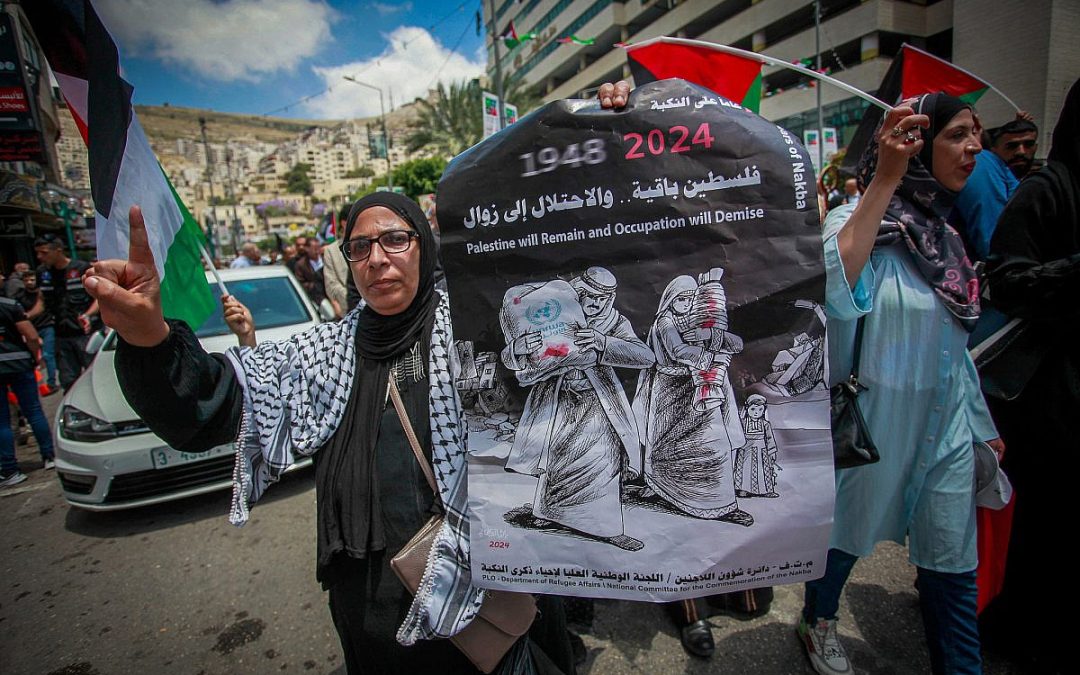
The establishment and destruction of Bab Al-Shams also echoes the dispossession of the Nakba, an echo surely not lost on Khoury, who has spent much of the last 20 years writing about the “continuous Nakba” — the ongoing cycle of violence committed against the Palestinian people. The Nakba, as he and all Palestinians contend, was not a single event that occurred in 1948, but rather a persevering process of dislocation and violence.
Telling the story of the Nakba, the catastrophic displacement of Palestinians in 1948, is a complex and ongoing process precisely because its consequences continue to shape the lives of Palestinians today. The Nakba is not just a historical event but an ongoing experience of dispossession, displacement, and loss that reverberates through generations.
One way to tell this ongoing story is by centering the voices and experiences of Palestinian refugees and their descendants who continue to grapple with the legacy of the Nakba. Their stories provide valuable insights into the enduring trauma, resilience, and aspirations for justice and return.
Another approach is to contextualize the Nakba within the broader framework of the Israeli-Palestinian conflict, highlighting its significance as a foundational injustice that underpins ongoing struggles for self-determination, human rights, and equality.
Furthermore, telling the story of the Nakba involves acknowledging and confronting the complexities and contradictions inherent in the narratives surrounding the conflict. This includes addressing competing historical narratives, challenging stereotypes and misconceptions, and promoting empathy, understanding, and reconciliation.
Ultimately, telling the story of the Nakba when the plot hasn’t ended requires a commitment to truth-telling, dialogue, and advocacy for justice and accountability. It involves recognizing the ongoing impact of historical injustices and working towards a future where the rights and dignity of all people, including Palestinians, are respected and upheld.
To read more detailed coverage check out the source of this news:
https://www.972mag.com/elias-khoury-continuous-nakba-review/