
This headline features a pro-Palestine Jewish activist who identifies as anti-Zionist but emphasizes that their stance is not rooted in anti-Semitism. It highlights a nuanced perspective within the Jewish community regarding the Israeli-Palestinian conflict. While Zionism is a political ideology supporting the establishment and maintenance of a Jewish state in Israel, criticism of Zionism does not necessarily equate to anti-Semitism, as some individuals oppose specific policies or actions of the Israeli government without harboring prejudice against Jewish people. This distinction is crucial in discussions about the conflict and related social and political movements.
“If you criticize Israel, you are called anti-Semitic. I want to break this discourse because I am an anti-Zionist Jewish,” said Jewish activist, Dalia Sarig-Fellner.
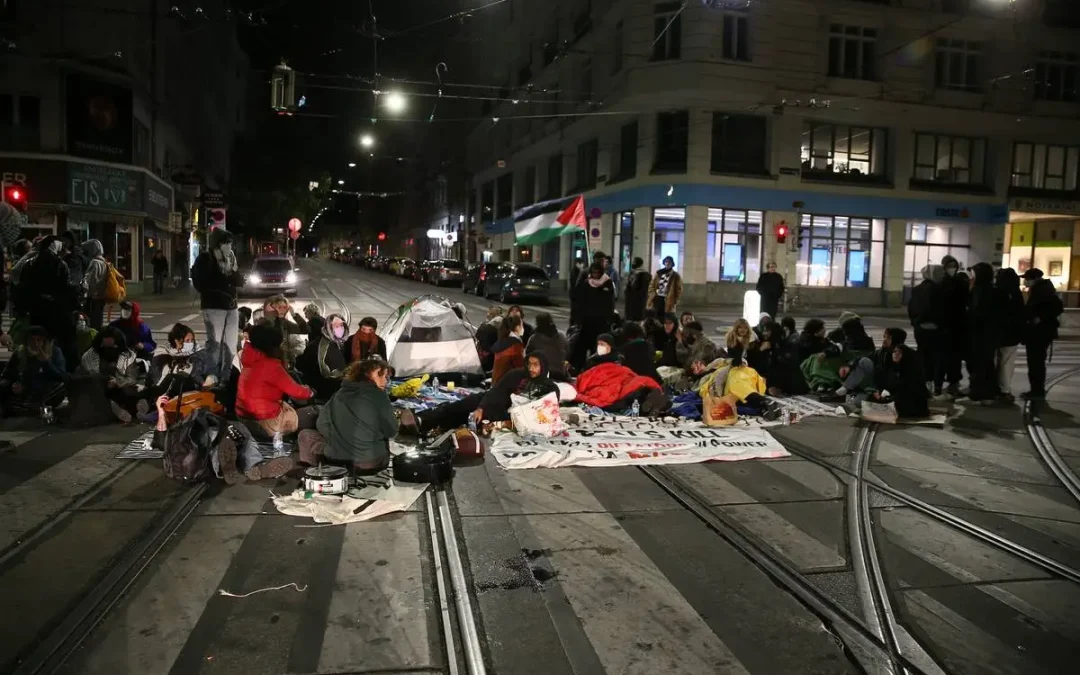
The Austrian activist of Jewish origin is known for the effective demonstrations she organised in Austria to make the voice of the Palestinian people heard and to highlight the humanitarian crisis in Gaza after Israel’s unremitting attacks on the Strip began over seven months ago.
She told Anadolu about the accusations she was subjected to by her close circle due to the protests she organised, the attitude of the Israeli public towards the events in Gaza and the large-scale demonstration she will organise in the Austrian capital, Vienna.
The activist explained that she started living in Austria after spending a certain part of her life in Israel. She said that she faced serious problems with her family and close circle after she took an active part in pro-Palestinian demonstrations after 7 October, 2023.
Genocide in Gaza and anti-Semitic accusations
“Since I started the (Palestinian) protests, my family stopped speaking to me,” she lamented.
“The Jewish community accuses me of being anti-Semitic,” Sarig-Fellner said, adding that she had expected this to happen to her before she started the protests, but that what she was going through was nothing compared to what is happening in Gaza.
The activist stressed that she was aware that the term “genocide” in the Strip has a sensitive place in Jewish history, adding that: “I made this statement consciously because many jurists believe that (what happened) was genocide.”
“The Court of Justice of the EU also points to a possible genocide,” she emphasised. “When I look at the visuals and what I have seen of what happened, it reminds me of genocide.”
Sarig-Fellner said that she faced the accusation of “trivialising the Holocaust” by telling the story of her grandfather, who had to leave Austria in 1938 due to Nazi persecution, in a show.
She pointed out that the views suggesting that the Israeli public is unaware of the attacks on Gaza and subjected to a form of blackout do not reflect reality.
“The majority of the Israeli population are soldiers. They are either mandatory conscripts or reservists,” she said, adding: “They are the ones doing this (what’s happening in Gaza); they are there, and what’s happening in Gaza cannot be hidden in any way.”
“It’s impossible,” she underscored. “A person born in Israel is raised completely brainwashed.”
“Palestinians have been ignored in history books, films and art. They have not been seen as people with emotions by governments,” she criticised.
Palestinians seen as enemies
Referring to the blocking or damaging of aid to Gaza by some Israelis, who see Palestinians as enemies, the Jewish activist said: “There is a prevailing belief that Palestinians, Arabs or, perhaps, Muslims cannot be trusted.”
“They are not telling the truth; in fact, they want to drown Jews in the sea,” she stressed. “This is entirely deep-seated racism and it is entirely pervasive in all school textbooks, in people’s emotions, in the country’s atmosphere.”
“Almost everyone thinks this way,” she underlined.
Sarig-Fellner mentioned that the understanding of the “Promised Land” is predominantly prevalent among marginal religious groups, but these groups have significantly increased in recent years, with half of the country thinking this way.
Recalling that Israeli Prime Minister, Benjamin Netanyahu, formed a coalition government with these religious groups, she explained that these groups proposed a legal reform advocating for the legalisation of religious values rather than democratic values, leading to serious tension in the country before 7 October, 2023.
‘We are Jews, but we are not Zionists’
The activist further pointed out: “The state of Israel wanted to promote that Judaism and Zionism are connected.”
“This means that if you criticise Israel, you are anti-Semitic,” she stressed. “I want to break this discourse because I am an anti-Zionist Jew.”
“There are many Jews who feel this way, especially in the US, but there are Jews here in Europe who are against this approach and they say: ‘We are Jews, but we are not Zionists’.”
After 7 October, Sarig-Fellner also referred to the rumours that there are a considerable number of Israelis who want to leave Israel for security reasons or are considering doing so: “Those who have European or foreign passports, their suitcases are ready.”
“If the situation in Israel worsens or if, for example, we become a democratic country and the Palestinians have equal rights, then they will not want to live in such a country and they will leave Israel.”
“Quite a lot of people (think this way),” she asserted.
Sarig-Fellner, who has staged effective protests, including outside the Austrian Parliament and the Foreign Ministry, said she is preparing a major demonstration on 15 May, the anniversary of the Nakba (Great Catastrophe).
Massive pro-Palestinian demonstration on 18 May
The activist said that since 15 May falls on a weekday, they will organise a large Palestinian demonstration in the capital, Vienna, on Saturday, 18 May, with participants from different parts of the country.
“We want to show that we are the majority and we will not let them delegitimise us,” she underlined. “The Palestinian demonstrations are not extremist or anti-Semitic, but a simple act of solidarity.”
Saying that many people in the country are worried that they might face problems if they participate in demonstrations in support of Palestine, Sarig-Fellner added that they will try to show that taking part in Palestinian demonstrations is not anti-Semitic, with intense participation from different sectors.
Earlier, the UN agency for Palestinian refugees, (UNRWA), said over 10,000 women have been killed and 19,000 injured in the Gaza war, adding: “The war in Gaza continues to be a war on women.”
The agency also said: “37 children lose their mother every single day.”
Israel has pounded the Gaza Strip in retaliation for a Hamas attack last 7 October, which killed 1,200 people. More than 34,900 Palestinians have since been killed in Gaza, mostly women and children, and over 78,500 others injured, according to Palestinian health authorities.
However, since then, it has been revealed by Haaretz that helicopters and tanks of the Israeli army had, in fact, killed many of the 1,139 soldiers and civilians claimed by Israel to have been killed by the Palestinian Resistance.
Over seven months into the Israeli war, vast swathes of Gaza lay in ruins, pushing 85 per cent of the enclave’s population into internal displacement amid a crippling blockade of food, clean water and medicine, according to the UN.
Israel stands accused of genocide at the International Court of Justice (ICJ) which, in January, issued an interim ruling that ordered it to stop genocidal acts and take measures to guarantee that humanitarian assistance is provided to civilians in Gaza.
To read more detailed coverage check out the source of this news: