
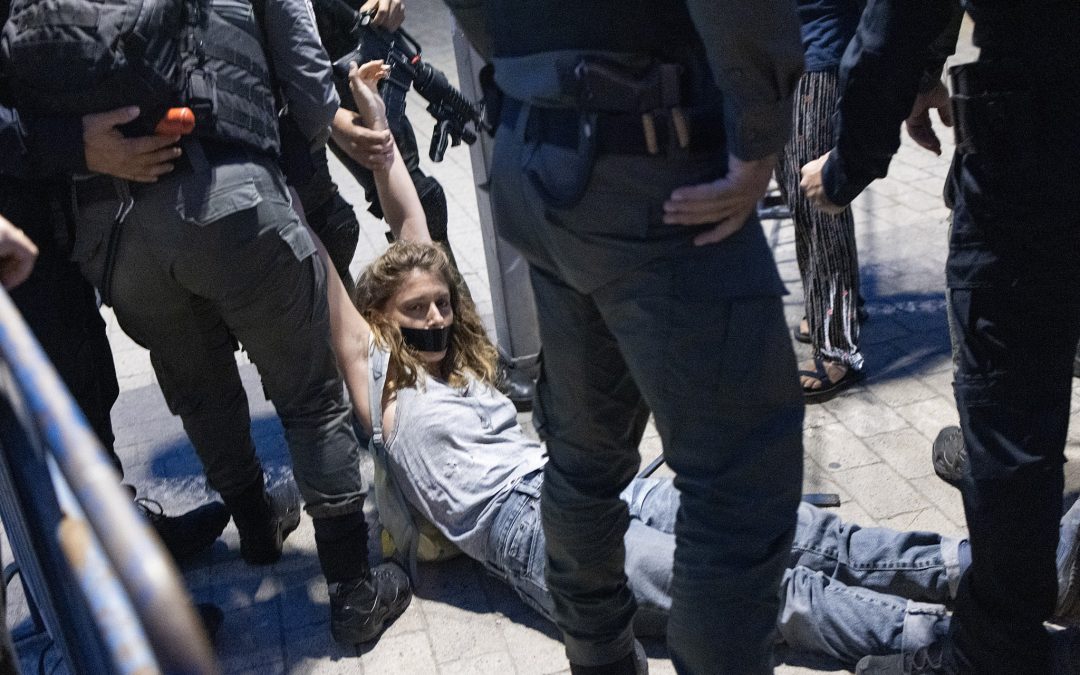
On the evening of Jan. 16, several dozen activists gathered in front of the Kirya in Tel Aviv, home to Israel’s Defense Ministry and army headquarters. It was one of the first Jewish-Israeli demonstrations explicitly condemning the military’s assault on the Gaza Strip since the war began, and the police acted swiftly to suppress it: dozens of officers were deployed in advance, and they refused to allow the protest to take place in its intended location. They confiscated signs reading “Stop the massacre” on the grounds that these offended public sentiment. One activist was arrested, and several others were assaulted by police.
This sequence of events is far from exceptional. Since October 7, Israel’s police have been implementing a consistent policy of preventing or limiting any protest against the war — in contrast to protests in solidarity with the hostages and their families, which have been permitted in certain areas. This policy is still in effect despite Israel’s Supreme Court issuing an interim injunction earlier this month prohibiting National Security Minister Itamar Ben Gvir from interfering with the policing of demonstrations; in large part, police appear nonetheless to be enforcing the minister’s desired crackdown on freedom of expression during the war.
Anti-war activists across the country — Palestinian citizens as well as Jews — who were interviewed for this article all mentioned one word: “fear.” Even veteran political activists say they have never been so fearful of protesting. They are afraid of being arrested, which for Palestinian citizens could spell months in prison. More than ever, they said, it is dangerous to show solidarity with the people of Gaza, and they feel that politicians’ belligerent rhetoric is directly impacting police behavior.
The activists’ characterization of Israeli police actions as repressive and heavy-handed underscores the tense dynamics surrounding anti-war protests. The term “iron fist” implies a harsh and authoritarian approach to quelling dissent, suggesting that protesters are facing significant obstacles and resistance from law enforcement.
Such descriptions highlight concerns about freedom of expression and assembly in Israel, as well as the broader political climate during times of conflict. Critics argue that the use of force to suppress peaceful demonstrations stifles democratic principles and undermines the right to dissent.
The portrayal of Israeli police actions as repressive adds another layer to the ongoing debate surrounding the Israeli-Palestinian conflict and the domestic response to public dissent within Israel. It reflects the complexities and challenges of navigating issues of security, civil liberties, and human rights in a deeply polarized and volatile context.
To read more detailed coverage check out the source of this news:
https://www.972mag.com/israel-police-repression-protests-gaza/