
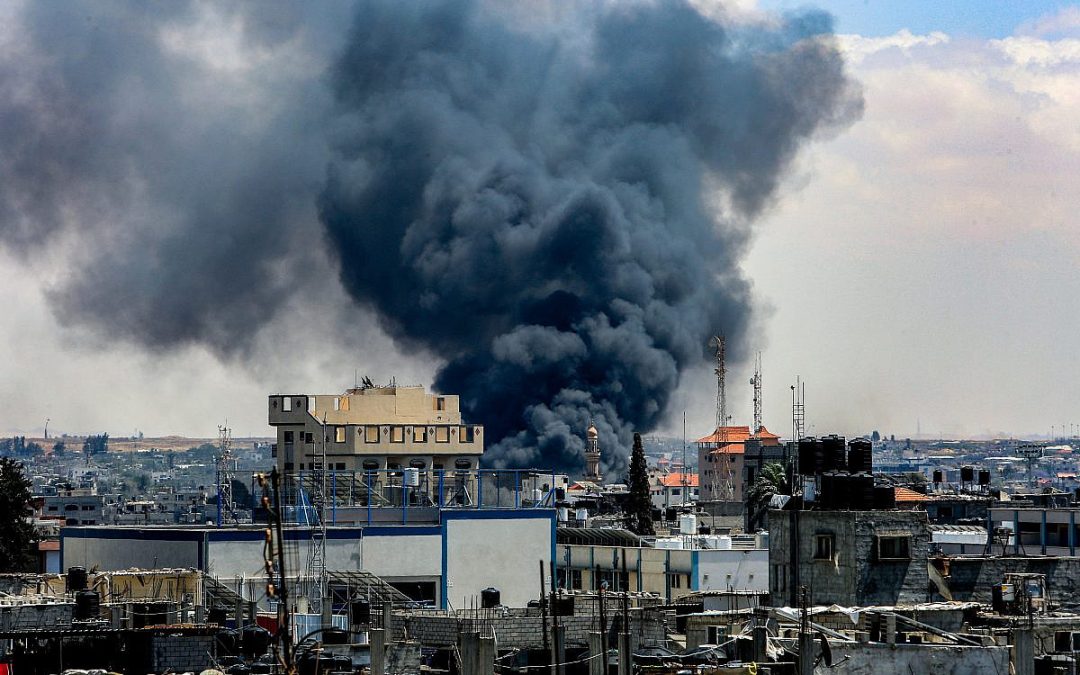
Israel’s long-threatened invasion of Rafah has begun. Under cover of intense aerial bombardment Tuesday morning, Israeli forces moved into Gaza’s southernmost city, which has become a shelter for 1.5 million Palestinians with nowhere else to go. This is the moment they most feared, carrying the potential for a catastrophe greater than anything we’ve seen so far. Gazans counted on the world to stop this invasion, and the world let them down.
Residents of Rafah have long been in a state of panic in anticipation of this eventuality. That panic intensified Monday morning, when the Israeli army dropped leaflets from the sky ordering those living in Rafah’s eastern districts to immediately flee to the ill-equipped coastal area of Al-Mawasi.
Within hours, tens of thousands packed up what remains of their lives — many of them for the third, fourth, or fifth time since October — and headed northwest to what Israel is calling an “expanded safe zone.” But if Palestinians have learned anything from the past seven months, it is that nowhere in Gaza is ever safe from Israel’s onslaught.
“Since the first day of displacement, I have been living in fear,” 48-year-old Reem Al-Barbari told +972. “I was displaced from Gaza City five months ago and took refuge in Rafah straight away, as the army told us it was a ‘safe area.’ But on Monday morning, leaflets fell instructing us to evacuate, and there was intense bombing throughout the night into Tuesday.
“The sky turned red from the intensity of the explosions,” Al-Barbari continued. “We were unable to sleep at all as we waited for the morning hours to uproot our lives again. The streets were very crowded with citizens — everyone was fleeing.”
Al-Barbari had hoped that when the time finally came to leave Rafah, it would be to return to her home in the Zaytoun neighborhood of Gaza City. “I left crying,” she said. “We went to look for somewhere to stay around Al-Mawasi, where I have no relatives or friends. We were hosted temporarily by other families displaced from Gaza City until we found a tent for ourselves.
“The situation is very painful,” Al-Barbari added. “Our feelings cannot be expressed in words. We are living through a cruel injustice, and the war is only intensifying. We, the citizens, are its victims.”
The statement describes a situation where there is panic and fear in Rafah, a city in the southern Gaza Strip, as an Israeli invasion begins. The reference to “scenes of the Nakba” suggests a comparison to the historical event known as the Nakba, which translates to “catastrophe” in Arabic and refers to the displacement and dispossession of hundreds of thousands of Palestinians during the 1948 Arab-Israeli war.
Drawing parallels to the Nakba implies that the current situation is reminiscent of past traumatic experiences for Palestinians, particularly in terms of displacement, loss, and the threat of violence. The use of the term “invasion” suggests a large-scale military operation by Israeli forces in the area, likely leading to widespread disruption, destruction, and civilian casualties.
This description underscores the grave humanitarian consequences of conflict in the Gaza Strip, where civilian populations are often caught in the crossfire and endure immense suffering. It also highlights the enduring trauma and collective memory of historical events like the Nakba, which continue to shape perceptions and responses to contemporary events in the Israeli-Palestinian conflict.
To read more detailed coverage check out the source of this news: