
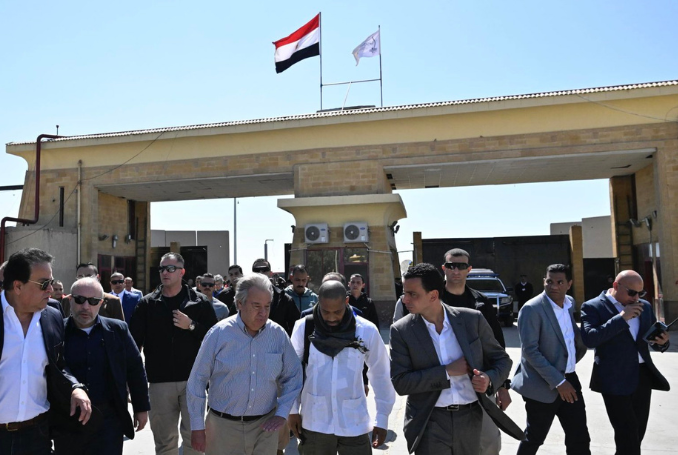
The warning from the UN Chief about the devastating consequences of the invasion of Rafah underscores the urgent need for immediate action to prevent further loss of life and humanitarian catastrophe in the region.
Describing the situation as “intolerable,” the UN Chief’s statement reflects the gravity of the crisis unfolding in Rafah, where civilian lives are at grave risk amid escalating violence and military operations. The invasion of Rafah not only poses an immediate threat to the safety and well-being of civilians in the area but also risks exacerbating the already dire humanitarian situation in Gaza.
The UN Chief’s warning serves as a stark reminder of the imperative for all parties involved to adhere to their obligations under international humanitarian law, including the principles of proportionality, distinction, and protection of civilians. It underscores the urgent need for a cessation of hostilities and the resumption of diplomatic efforts to achieve a sustainable ceasefire and address the root causes of the conflict.
Furthermore, the UN Chief’s statement highlights the critical role of the international community in supporting humanitarian assistance efforts and ensuring access to essential services for those affected by the violence. It calls on the international community to step up its efforts to provide humanitarian aid, protect civilian populations, and address the underlying drivers of the crisis.
In light of the UN Chief’s warning, it is imperative that all parties involved in the conflict prioritize the protection of civilian lives and work towards a peaceful resolution that respects the rights and dignity of all people in the region. Only through concerted diplomatic efforts and a commitment to international law can we hope to avert further devastation and pave the way for a future of peace and stability in Rafah and beyond.
“A ground invasion in Rafah would be intolerable because of its devastating humanitarian consequences and because of its destabilizing impact in the region.”
UN Secretary-General Antonio Guterres has said that an Israeli ground invasion of the southern Gaza town of Rafah would be “intolerable” because of its devastating humanitarian consequences.
Speaking ahead of his meeting with Italian President Sergio Mattarella at the UN headquarters in New York on Monday, Guterres said “I receive you Mr. President in a moment of great concern. I made today a very strong appeal to the government of Israel and to the leadership of Hamas in order to go an extra mile to materialize an agreement that is absolutely vital.”
“This is an opportunity that cannot be missed. A ground invasion in Rafah would be intolerable because of its devastating humanitarian consequences and because of its destabilizing impact in the region,” Guterres added.
Key Demands’ Not Met
Following the announcement by the Palestinian Resistance Movement Hamas of its acceptance of a Qatari-Egyptian proposal for a ceasefire in Gaza, Israel’s war cabinet decided to push ahead with an operation in Rafah.
Israel reportedly said the truce offer accepted by Hamas does not meet its key demands.
The Israeli army issued evacuation orders early on Monday for Palestinians in the eastern neighborhoods of Rafah and called on them to move to the town of Al-Mawasi in southern Gaza. Approximately 100,000 Palestinians residing in the eastern neighborhoods of Rafah are affected by this evacuation process.
In a statement on Tuesday, Hamas called on the US administration and the international community “to pressure the occupation to stop this escalation that threatens the lives of hundreds of thousands of displaced civilians in Rafah and throughout the Gaza Strip.”
Roughly 1.5 million displaced Palestinians are sheltering in Rafah, with many having been displaced from other areas destroyed by Israel in its ongoing military assault on the besieged enclave.
UNRWA Warning
The UN Agency for Palestine Refugees (UNRWA) warned on Tuesday that the interruption to the supply of aid at the crossing will affect the humanitarian response across the besieged enclave.
“Continued interruption of the entry of aid and fuel supplies at the Rafah crossing will halt the critical humanitarian response across the Gaza Strip,” UNRWA said on X.
“The catastrophic hunger faced by people especially in northern Gaza will get much worse if these supply routes are interrupted,” the organization added.
Speaking from Rafah on Tuesday, UNRWA’s Communications Officer, Louise Wateridge, said “For us here in Rafah there’s just a lot of fear. Everywhere you look, there’s fear. Nobody has a clear path where to go. There is no advice on where to go. There is no safety to be led to.”
Over 34,700 Killed
Currently on trial before the International Court of Justice for genocide against Palestinians, Israel has been waging a devastating war on Gaza since October 7.
According to Gaza’s Ministry of Health, 34,789 Palestinians have been killed, and 78,204 wounded in Israel’s ongoing genocide in Gaza starting on October 7.
Moreover, at least 11,000 people are unaccounted for, presumed dead under the rubble of their homes throughout the Strip.
Palestinian and international organizations say that the majority of those killed and wounded are women and children.
The Israeli war has resulted in an acute famine, mostly in northern Gaza, resulting in the death of many Palestinians, mostly children.
The Israeli aggression has also resulted in the forceful displacement of nearly two million people from all over the Gaza Strip, with the vast majority of the displaced forced into the densely crowded southern city of Rafah near the border with Egypt – in what has become Palestine’s largest mass exodus since the 1948 Nakba.
Israel says that 1,200 soldiers and civilians were killed during the Al-Aqsa Flood Operation on October 7. Israeli media published reports suggesting that many Israelis were killed on that day by ‘friendly fire’.
To read more detailed coverage check out the source of this news: