
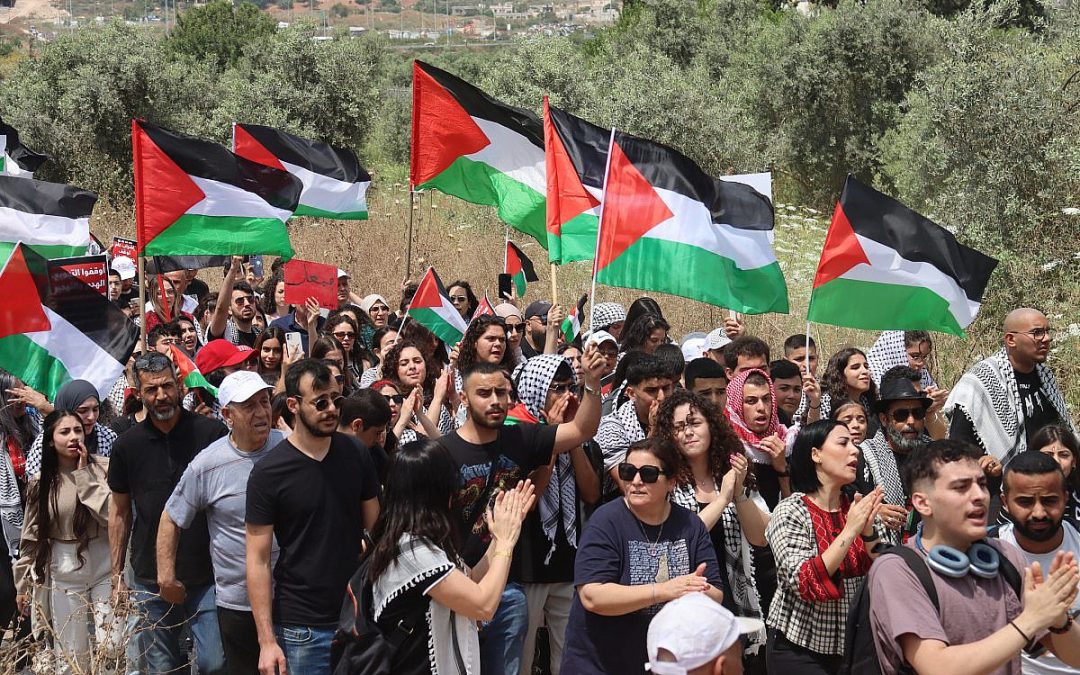
In the shadow of what many Palestinians are describing as a second Nakba in Gaza, around 15,000 Palestinian citizens of Israel participated in the 27th annual March of Return on Tuesday. After gathering in the northern city of Shefa-Amr, participants marched to the site of Hawsha and Al-Kasair, Palestinian villages that were forcibly depopulated during the Nakba of 1948 and subsequently destroyed.
Although Nakba Day is officially marked on May 15, the March of Return is held every year on Israel’s Independence Day, under the slogan “Their independence is our Nakba.” In recent years, the march has become the central mobilizing event for Palestinian citizens of Israel, uniting all groups and political forces. It is organized by the Committee for the Defense of the Rights of the Internally Displaced Persons in Israel, which selects one of the more than 600 Palestinian localities uprooted by Zionist or Israeli militias in 1947-49 as the march’s destination.
The number of Palestinians who were expelled or forced to flee from their homes in those years and prevented from returning was around 750,000; the number displaced in Gaza since October 7 exceeds 1.9 million.
“Without a doubt, this year’s march is different from all its predecessors, although marches took place in the past under difficult circumstances for the Palestinian people,” said journalist and activist Makbula Nassar, a member of the organizing committee. “As we march to emphasize our commitment to the UN-recognized Right of Return, hundreds of thousands of Palestinians — the children and grandchildren of those displaced in 1948 — are living once again through mass displacement.”
Commemorating the Nakba under the present circumstances, Nassar explained, is “a real challenge, but we are not compromising on continuing our activity, which has been going on for years. Its value has grown in recent years as a unifying event that speaks to all members of Arab society, although this year, the accompanying feelings are much more difficult.”
The Nakba commemoration holds profound significance for Palestinians, transcending mere remembrance to embody a steadfast commitment to their identity, heritage, and rights. It is a collective acknowledgment of the injustices endured by generations past and present, while also serving as a call to action for future generations. The shadow of the Gaza war casts a somber light on these commemorations, emphasizing the ongoing struggles faced by Palestinians, particularly those in Gaza who bear the brunt of violence and displacement.
Against the backdrop of conflict and adversity, Nakba commemorations become moments of resilience and defiance, where Palestinians assert their narrative and demand recognition of their right to self-determination and return. The fourth generation, born into a reality shaped by displacement and occupation, carries the torch of remembrance forward, ensuring that the memory of the Nakba remains alive and relevant in their quest for justice and freedom.
In the face of challenges, Nakba commemorations also serve as acts of resistance, challenging the erasure of Palestinian history and asserting the enduring presence and resilience of the Palestinian people. They are reminders that, despite the passage of time and the persistence of oppression, the spirit of resistance and hope for a better future remains unbroken.
To read more detailed coverage check out the source of this news: