
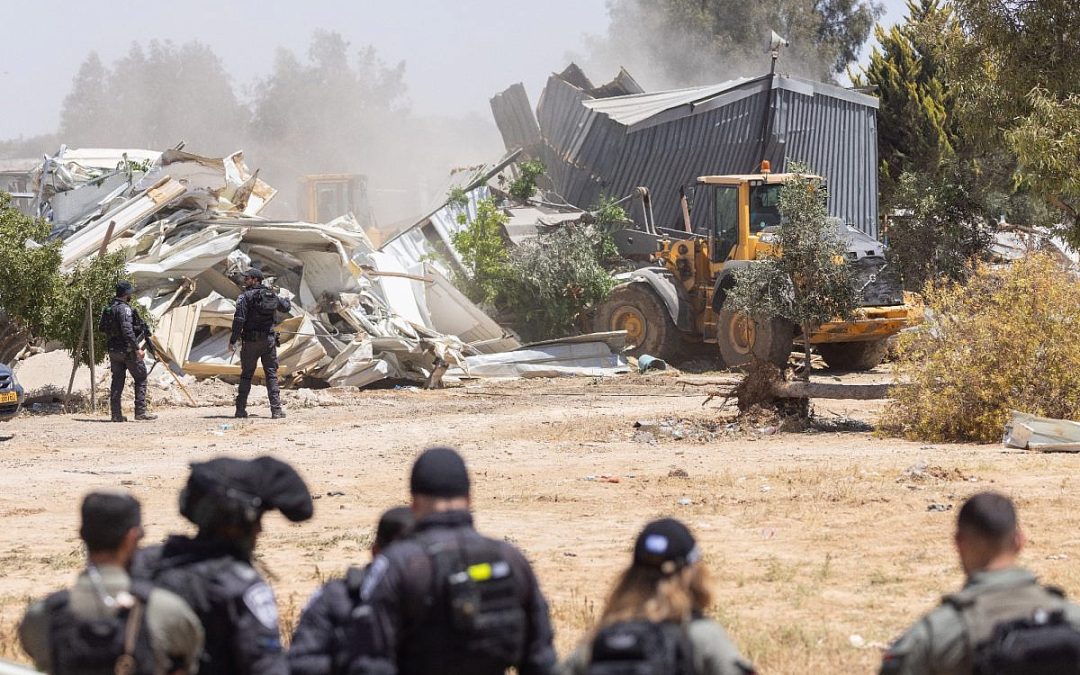
On the morning of May 8, Israeli forces razed the entire Bedouin village of Wadi al-Khalil in the Naqab/Negev desert. The demolitions, which were carried out in order to expand the Route 6 highway, left more than 300 residents homeless.
Wadi al-Khalil is one of 35 Bedouin villages in the Naqab whose existence the Israeli authorities do not officially recognize; as a result, the villages, which are home to around 150,000 Bedouin Arab citizens of Israel, face the constant threat of demolition. Many of the villages are decades old — some even pre-date Israel’s establishment — but they are prevented from connecting to state infrastructure including water and electricity, and their residents are denied municipal services.
According to the Regional Council for the Unrecognized Bedouin Villages, Wednesday’s demolition was the largest in the Naqab for 14 years. It comes as Israel’s National Security Minister Itamar Ben Gvir vows to crack down on what he calls “lawbreakers” and restore meshilut — literally “governance,” a euphemism for Jewish-Israeli control — to the area. Eight other unrecognized villages are currently under threat of forced eviction under the guise of urban development.
The police’s arrival in the village was not met with resistance. Officers pushed the residents and a handful of solidarity activists to the outskirts of the village before bringing in trucks and bulldozers. Contractors in yellow vests removed furniture and any personal items that had been left inside the residents’ homes and loaded them onto the trucks. A few horses and camels wandered restlessly between the officers and vehicles as the bulldozers got to work.
“You work eight or nine years, saving money to build a house, and then they destroy it,” Yousef Abu Issa, a 35-year-old resident, told +972 and Local Call. “They don’t give you another place to live, they don’t help you.”
The demolition of an entire Bedouin village to expand a highway represents a grave violation of human rights and underscores the ongoing displacement and dispossession faced by indigenous Palestinian communities in Israel. Such actions not only result in the forced eviction of residents from their ancestral lands but also perpetuate a long history of discrimination, marginalization, and land confiscation against the Bedouin population.
The destruction of homes and livelihoods in the village further exacerbates the vulnerability and insecurity of affected families, many of whom are already living in precarious conditions with limited access to basic services and opportunities for economic development.
Moreover, the expansion of the highway at the expense of the Bedouin village reflects the prioritization of infrastructure projects over the rights and well-being of indigenous communities. It highlights the structural inequalities and power imbalances that exist within Israeli society and the broader context of the Israeli-Palestinian conflict.
The international community must condemn the demolition of the Bedouin village and call on Israel to halt its policies of forced displacement and land confiscation. Efforts should be made to hold Israel accountable for its violations of international law, including its obligations under the Fourth Geneva Convention, which prohibits the destruction of property and the forcible transfer of civilians in occupied territories.
Furthermore, support should be provided to affected Bedouin communities to ensure their rights to housing, land, and natural resources are respected and protected. Dialogue and engagement with indigenous leaders and grassroots organizations are essential for promoting justice, equality, and reconciliation in Israel and the broader region.
To read more detailed coverage check out the source of this news: